How do I prepare for birth when I don’t know how it will unfold?
There is a strange tension in preparing for birth.
You are asked to get ready for something that cannot be fully predicted.
You can read the books.
Attend the appointments.
Write the birth preferences.
Pack the bag.
And still, birth may unfold differently from the picture you had in your mind.
For some women, that uncertainty feels exciting.
For others, it feels deeply uncomfortable.
Because when we don’t know what is going to happen, the natural instinct is often to look for certainty.
To ask:
What should I do?
What should I choose?
What is the “right” way to give birth?
How do I make sure everything goes to plan?
Can I make sure everything goes to plan?
For most of us the uncomfortable truth is that preparation for birth is not really about learning how to control every possible outcome. Because we just can’t.
It is about building the capacity to meet what comes.
Busting the mystery but keeping the magic of birth…
The more you understand about birth, the less mysterious it becomes.
That does not mean you need to know every possible scenario.
It means getting clear on the controllables and not leaving those to chance
It also means searching for and finding peace with the things we cannot control.
How to do this can sound so simple but feel like the impossible.
But understanding leads to familiarity which then gives you something to stand on when things feel unfamiliar.
It allows you to participate in decisions rather than simply feel that things are happening around you.
We often think that what matter is the “what” happens….
Birth preferences are absolutely useful.
The exploration of them before the day helps you know your options and how you feel about them and what you think you might need.
But the most important part is not always the exact list of things you want to happen or not to happen.
It is understanding why those things matter to you and what you need in and around the why’s to feel safe.
Maybe privacy matters deeply.
Maybe you need time to process information.
Maybe you feel safer when people explain what they are doing before they touch you.
Maybe you want your partner included in conversations.
When you understand your values and what is driving them, you can grow your tools to protect them, and ultimately you, even if the details of your birth change.
A plan can change.
Your values do not have to.
Shifting the fear to ask questions of your care providers about your care….
There may be moments during pregnancy or labour when someone suggests an intervention, a test, a change in plan or moves to do something to you or touch you that you feel unsure of.
You do not need to know everything in order to ask for a time out and ask a question.
Sometimes it is enough to ask:
Can we take a minute I just need to know….
Why are you recommending this?
What are the benefits?
What are the risks?
What happens if we wait?
Are there other options?
Do we need to decide right now?
Those questions create space.
And with that space you as a pregnant, birthing or new parent become active in the decision making about your care or the care of your newborn.
Prepare Your Birthing Partner to Be Your Champion
Birth preparation is not only for the woman giving birth.
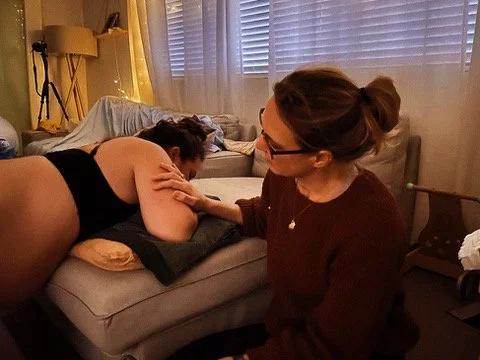
Your birth partner plays an important role in how you feel during labour and birth, and in the experience you carry with you long after your baby is born.
That support becomes so much more meaningful when your birth partner is brought into not only the ecosystem of labour and birth, but your ecosystem.
Birth has its own physiology. Its own rhythms, sounds, sensations and behaviours. Understanding what that physiology looks, sounds and feels like from the outside is important. But equally important is understanding what it might feel like for the woman experiencing it from the inside.
When your birth partner understands both, they are better placed to recognise what is unfolding, what might be needed and, just as importantly, when nothing needs to be done at all.
They begin to understand what helps this ecosystem flourish and what might interrupt it.
But there is another layer to this preparation.
Understanding you.
How do you respond when you feel overwhelmed?
What kind of reassurance actually works for you?
Do you like quiet, or do you find comfort in hearing a familiar voice?
Do you want someone to speak on your behalf when you feel vulnerable, or would you prefer they create the space for you to find your own words?
Do you appreciate reminders to breathe, move, drink or rest? Or might those reminders feel like another demand when you're working hard?
Do you like touch? And if so, how do you like to be touched?
What makes you feel safe?
What makes you feel observed, rather than supported?
These are conversations worth having well before labour begins.
Because being a wonderful birth partner isn't necessarily about knowing all the right things to say or having a collection of techniques ready to use.
Sometimes it is about knowing when to come closer, when to step back, when to offer something and when to simply be there.
It is about understanding the woman you are alongside, rather than arriving with a preconceived idea of what support should look like.
And of course, what feels right in pregnancy may not feel right in labour. Your needs may change from one moment to the next. A birth partner who understands this can remain curious, responsive and willing to adapt.
The aim isn't to choreograph your birth. It's to build a shared understanding that allows your birth partner to move alongside you, rather than trying to direct the experience.
Support works best when it isn't being improvised for the very first time in labour.
Preparing together creates an opportunity for your birth partner to become more than someone who is simply present.
Someone who knows you. Who understands the physiology of birth. Who recognises your capacity, respects your agency and knows how to protect the space you need.
Someone who can truly be your champion.
You are not preparing for a perfect birth
What if we shifted our focus away from preparing for a perfect birth and towards preparing for the experience of giving birth?
Not just what happens during labour, but how we experience it. How we feel within ourselves, how we relate to the people around us, and how we participate in the decisions being made about our care.
Birth preparation is so much more than learning the stages of labour, practising breathing techniques or writing a birth plan.
It is an opportunity to get curious.
To understand the physiology of birth and the incredible capacity of your body.
To explore what supports that physiology and what might interrupt it.
To understand the environment in which you feel safe, the people you want around you and the things that matter most to you.
To become familiar with your options, not simply so you can make decisions, but so you can understand what those decisions mean for you.
And perhaps most importantly, to understand yourself.
How do you respond when things feel intense?
What happens when you feel vulnerable?
What allows you to feel safe enough to let go?
What brings you back to yourself when you feel overwhelmed?
These are not questions with right or wrong answers. They are invitations to become more familiar with yourself before you step into the experience of labour and birth.
Because the way we experience birth matters.
How we are spoken to matters. How we are listened to matters. The relationships we have with those supporting us matter. And our capacity to remain connected to ourselves throughout the experience matters.
Birth preparation is not about becoming someone who knows exactly what to do. It is about building the understanding, awareness and capacity to participate in your own experience.
To recognise what is happening within your body.
To communicate what you need.
To ask questions and take the time to understand the answers.
To recognise that your voice belongs in every conversation about your care.
This is the kind of preparation that extends well beyond a checklist of things to do before your baby arrives.
It becomes part of how you move through birth and into motherhood.
And that, to me, is where birth preparation becomes really meaningful.
The Journey to Motherhood was created around this very philosophy. An opportunity to explore birth, your body, your relationships and yourself, with the understanding that you are an active participant in your own journey.