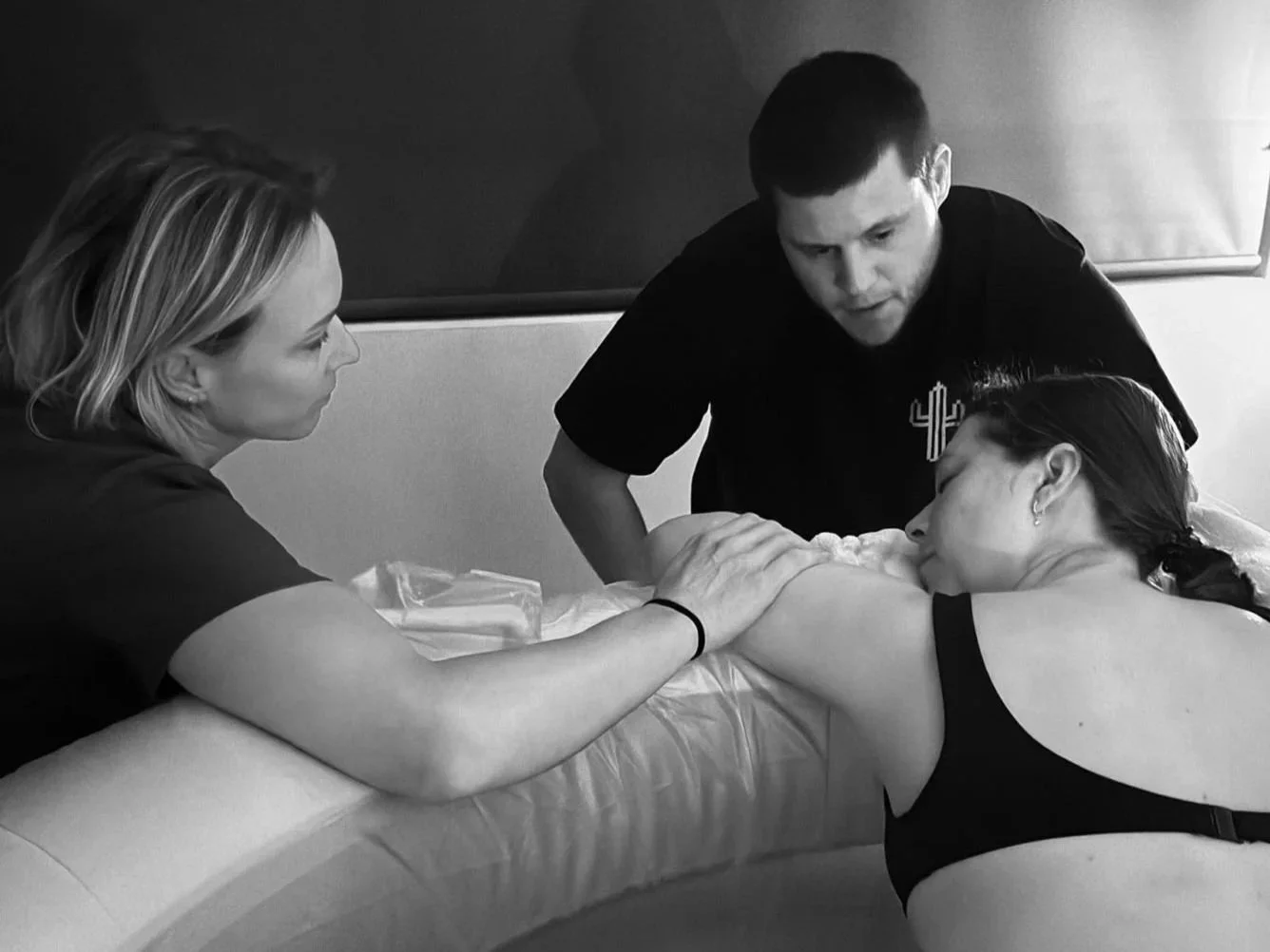
What questions should I ask before agreeing to an intervention in labour?
There may be moments during labour when someone recommends something you hadn't anticipated.
A vaginal examination. Continuous monitoring of your baby. Breaking your waters. Medication to strengthen contractions. An assisted birth or a caesarean section.
These are all things that may become part of the conversation during labour and birth.
And while understanding what these interventions involve is important, I think it's equally important to understand how we participate in the conversations surrounding them.
Because informed consent is so much more than being presented with information and being asked to say yes or no.
It is about understanding what is being recommended, why it is being recommended, what your options are and what those options mean for you.
It is about being an active participant in your own care.
Understanding the conversation
Labour is not necessarily the easiest environment in which to take on new information.
You may be deeply focused on the work your body is doing. You may be tired, feeling vulnerable or simply not wanting to engage in a lengthy conversation.
And suddenly you're being asked to consider something you haven't thought about before.
This is one of the reasons I believe birth preparation needs to go beyond understanding the physiology of labour.
We also need to explore the conversations that may happen around us, the language used and our relationship with decision making.
Not so we can anticipate every possible conversation, but so we become more familiar with how to participate in them.
There are some simple questions that can make an enormous difference.
Why are you recommending this?
This is often a really useful place to begin.
What is happening that has led to this recommendation?
Is there a particular concern about you or your baby?
Is this something routinely offered, or is there a specific reason it is being suggested in your circumstances?
Why now?
Understanding the reason behind a recommendation provides context for everything that follows.
It allows you to explore the recommendation rather than simply respond to it.
What are the benefits, and what are the risks?
Every intervention has a purpose, and understanding that purpose matters.
What is it expected to achieve?
What are the potential benefits for you and your baby?
And what are the potential risks or disadvantages?
This isn't about viewing interventions as something to avoid. They can be incredibly valuable and sometimes essential.
It's about having an understanding of the whole picture.
You might also want to explore whether an intervention changes the way your labour will be supported from that point onwards.
For example, does it mean additional monitoring, a change in your mobility or other interventions being recommended?
Understanding these things allows you to consider what the intervention means within the broader experience of your labour.
What are my alternatives?
I think this is a question we could all become more comfortable asking.
Are there other ways of approaching the situation?
What would those options involve?
What are their benefits and risks?
And how do they compare with what is being recommended?
Sometimes there are several reasonable options. Sometimes the circumstances make the options more limited.
But understanding what is available to you is an important part of informed decision making.
It also creates an opportunity to bring your own values and preferences into the conversation.
Because what matters to one woman may not be the same as what matters to another.
What happens if we do nothing, or wait?
This is another important part of understanding your options.
What might happen if we don't proceed with the recommendation?
Is there an opportunity to wait and reassess?
What would we be looking for during that time?
And what would prompt us to revisit the conversation?
Waiting is not always a reasonable or safe option, but understanding the implications of waiting, or declining an intervention, is part of informed consent too.
How urgent is this?
Not every recommendation carries the same level of urgency.
Sometimes there is time to consider the information, ask more questions and talk with the people supporting you.
Other times, decisions need to be made very quickly.
Understanding the urgency allows you to understand the space available for the conversation.
You can simply ask, "Is this an emergency, or do we have some time to talk?"
It's a reasonable question.
Can you explain that to me differently?
Medical language can be unfamiliar, particularly when you are hearing it for the first time during labour.
You may understand some of what is being said, but not all of it.
You might need someone to slow down, use different language or explain what a particular finding means.
You can ask for that.
Understanding isn't something that should be assumed simply because information has been provided.
And informed consent is not achieved by how much information someone gives you. It requires a genuine opportunity to understand that information.
Bringing your birth partner into the conversation
This is where preparing with your birth partner becomes particularly valuable.
When your partner understands not only the physiology of birth, but also you, your values and the things that matter to you, they are much better placed to support you within these conversations.
They can recognise when you need space.
They can ask for something to be explained again.
They can remind you of questions you wanted to ask.
They can recognise when you are feeling overwhelmed and support you in finding your footing.
And importantly, they can understand that their role is not to make decisions for you, but to support your capacity to participate in them.
These are conversations worth having together before labour begins.
Informed consent is not simply saying yes
One of the things I really want women to understand is that informed consent is not a formality.
It is an ongoing conversation.
It involves information, understanding, options and the freedom to make a decision.
And it includes the right to decline a recommendation or change your mind.
It is not about challenging every recommendation or feeling that you need to have the same clinical knowledge as the people caring for you.
It's about recognising that your knowledge of yourself is valuable within those conversations too.
Your care providers bring their clinical knowledge and experience.
You bring your knowledge of yourself, your body, your values and what matters to you.
Both belong in the conversation.
And this is something we can begin exploring long before labour starts.
We can practise asking questions. We can become familiar with the language of birth. We can explore how we respond when we feel vulnerable, uncertain or overwhelmed.
We can build relationships with our care providers where questions are welcomed and conversations are part of the care we receive.
Because informed consent shouldn't be something we suddenly need to navigate for the first time in the middle of labour.
It should be part of the ecosystem of care surrounding us throughout pregnancy, labour and birth.
The Journey to Motherhood explores informed consent, decision making, birth physiology and the relationships that shape our experience of birth.
Not to tell you what decisions to make, but to strengthen your understanding and capacity to make decisions that are meaningful to you.
Explore The Journey to Motherhood