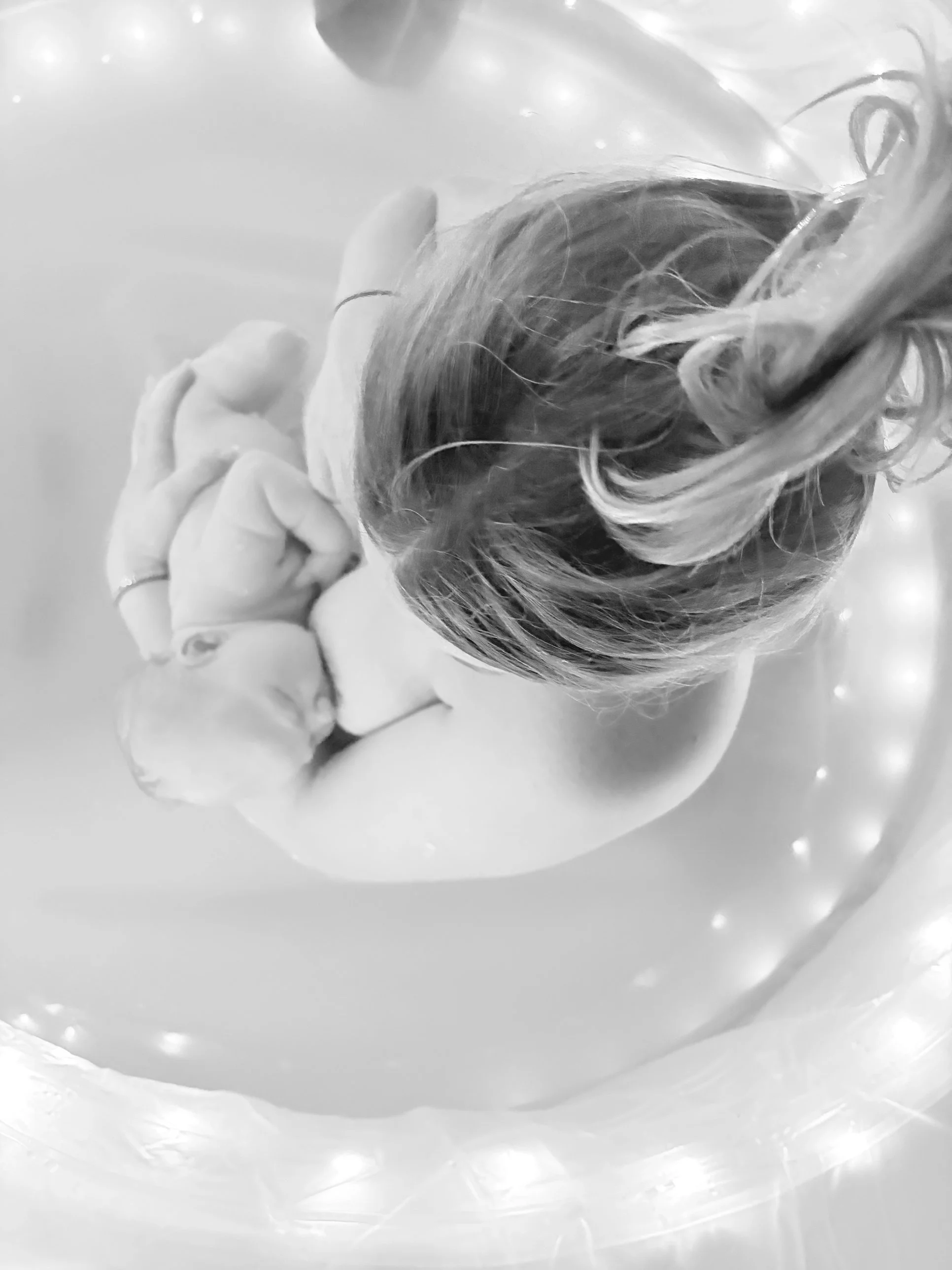
That first hour
I've been sitting with something lately. After all the months of growing a baby, and all the hours of labouring, there's this moment. Your baby is born, and for the first time you meet each other on the outside.
What happens next matters more than we often give it credit for.
In many births, that meeting gets interrupted. Baby is lifted away to be weighed, measured and checked across the room. Usually with the kindest of intentions, and often simply because that's how the system has always run. None of that is on the mother.
I want to talk about why time together matters, why protecting it sits with us as care providers, and how mothers and babies find their way back to each other when it's been interrupted.
What's unfolding in those first moments
Birth doesn't end when your baby arrives. Your bodies are still in conversation with each other.
In the minutes after birth, a mother's body can release some of the highest levels of oxytocin she'll ever experience. Kerstin Uvnäs Moberg, who has spent decades researching oxytocin, describes it as the hormone of calm and connection. It's part of what brings that rush of love, that softening, that pull towards your baby (1).
Baby is wired for this moment too. Skin to skin on mum's chest, a newborn's temperature, breathing and heart rate tend to settle (2). Researchers in Sweden have described nine instinctive stages a baby moves through when left undisturbed on their mother: a birth cry, relaxation, waking, small movements, resting, crawling towards the breast, familiarising, suckling and then sleep (3). It's extraordinary to witness. Babies know the way.
And it isn't a rushed, tidy hour. Left undisturbed, many newborns take their time with that first feed, often two to three hours. The first hour is a beginning, not a deadline.
I think of it as a dance. Mum's body responds to baby, and baby responds to mum. Each one cues the other.
When that dance is interrupted
So what happens when mum and baby are separated?
For baby, being away from mum's body seems to register as stress. One well-known study found that newborns placed in a cot cried far more than babies held skin to skin, and the researchers described it as a separation distress call (4). From a baby's point of view, mum's chest is home. It's warmth, food, smell, heartbeat. Everything familiar.
For mum, the flow of hormones that supports bonding and feeding can be disrupted. Some women describe a sense of distance afterwards, a quiet “is this really my baby?” That's not a reflection on them as mothers. It's a very human response to their first connection on the outside that was cut short.
And the effects may last beyond the birth room. A study from Russia compared babies who stayed skin to skin with their mothers to babies taken to a nursery for the first two hours. A year later, the mother–baby pairs who had been kept together showed more sensitive, responsive interaction with each other (5). Keeping mum and baby together after birth is also linked with babies breastfeeding more readily and for longer (2).
These early hours matter. But they aren't the whole story of a relationship, not by a long way.
Protecting connection is our job
I want to be really clear about where the responsibility sits. Staying together isn't something a woman should have to fight for in the hours after giving birth. It's on us, as midwives, doctors and nurses, to protect that space. That can look like newborn checks done on mum's chest, the weighing left until later, the lights low and the room quiet.
But care providers work inside systems. When midwives are stretched across too many women, short on staff and racing the clock, unhurried care is often the first thing to go. Research on midwifery continuity of care shows what's possible when women know their midwife, and midwives have the time and support to be fully present (8). If we want care providers to protect mothers and babies, our systems need to protect care providers.
Physician Gabor Maté has spent decades writing about trauma and attachment. He describes trauma not as what happens to us, but as what happens inside us as a result. He also writes about how many of our “normal” birth and early parenting practices quietly pull babies away from the bodies they depend on (9). That's a pattern in our culture and our systems. It isn't something any one mother caused.
Professor Helen Ball, an anthropologist who leads the Durham Infancy and Sleep Centre in the UK, reminds us that human babies are born biologically expecting closeness to their mothers. So many of our expectations of newborns don't match what their bodies actually need (10). Closeness isn't a habit to be trained out. It's the biological norm.
Finding each other again
I want to say this gently, because some of you reading will have been separated from your babies at birth.
Sometimes it's needed. Sometimes a baby or a mother needs care that can't happen in each other's arms. And sometimes it just happened, and no one asked.
Whatever your story, there's no blame here. Connection isn't a door that closes after the first hour. Babies keep seeking their mothers, and mothers keep finding their babies, in the days and weeks that follow. Skin to skin is just as available to you on day two, or week three, as it was in the birth room. Many women find that slow, quiet time skin to skin later on brings back some of what felt missed.
The research speaks to this too. Babies who start skin to skin later, even after time apart in special care, still show its benefits. One study followed premature babies whose mothers held them skin to skin in the weeks after birth, and found differences in how those children handled stress and attention ten years on (11).
Psychologist Edward Tronick spent decades watching mothers and babies together. He found that connection isn't built on getting every moment right. Everyday relationships are full of small ruptures and repairs, and it's the repair, again and again, that builds trust (12).
Some of the ways women describe reconnecting: lots of skin to skin, in bed, on the couch, in a warm bath together. Feeding, or simply holding, with no agenda. Telling the story of what happened, and grieving what was missed if that's what's there.
If your birth left you with feelings you're still carrying, those feelings are worth being heard. Talking them through with someone you trust, or with your own care provider, can be a really meaningful place to start.
Something to sit with before your birth
If you're pregnant now, you might like to think about what you'd want that first hour to look like. Some questions you could bring to your midwife or doctor:
What usually happens with babies straight after birth where I'm planning to give birth?
Can the newborn checks and weighing wait until after the first feed?
If I have a caesarean, is skin to skin in theatre an option? (6)
If my baby needs extra care, can my partner hold them skin to skin until I can?
What would need to happen for my baby and me to stay together?
The World Health Organization recommends that well babies stay skin to skin with their mothers in the first hour after birth (7). So these are reasonable things to ask about. Every birth place does things a little differently, and your care provider is the best person to talk through what's possible for you.
That first meeting belongs to you and your baby. It's worth protecting, and protecting it is our job, alongside you. And if it didn't unfold the way you'd hoped, there's still so much time to find each other.
Abbey x
Keep exploring
Preparing for birth? The Journey to Motherhood is my online birth preparation course, with a whole lesson on after birth and the golden hours.
Join my free Understanding Birth webinar for women and partners.
Getting older siblings ready? We're Having a Baby shows homebirth through a child's eyes.
Midwife or doula? Join The Art and Science of Midwifery webinars.
Planning a homebirth in Perth? Read about homebirth with me.
References
Uvnäs Moberg K. Oxytocin: The Biological Guide to Motherhood. Amarillo, TX: Praeclarus Press; 2016.
Moore ER, Bergman N, Anderson GC, Medley N. Early skin-to-skin contact for mothers and their healthy newborn infants. Cochrane Database of Systematic Reviews. 2016;(11):CD003519.
Widström AM, Brimdyr K, Svensson K, Cadwell K, Nissen E. Skin-to-skin contact the first hour after birth, underlying implications and clinical practice. Acta Paediatrica. 2019;108(7):1192–1204.
Christensson K, Cabrera T, Christensson E, Uvnäs-Moberg K, Winberg J. Separation distress call in the human neonate in the absence of maternal body contact. Acta Paediatrica. 1995;84(5):468–473.
Bystrova K, Ivanova V, Edhborg M, et al. Early contact versus separation: effects on mother–infant interaction one year later. Birth. 2009;36(2):97–109.
Stevens J, Schmied V, Burns E, Dahlen H. Immediate or early skin-to-skin contact after a caesarean section: a review of the literature. Maternal & Child Nutrition. 2014;10(4):456–473.
World Health Organization. WHO Recommendations: Intrapartum Care for a Positive Childbirth Experience. Geneva: WHO; 2018.
Sandall J, Soltani H, Gates S, Shennan A, Devane D. Midwife-led continuity models versus other models of care for childbearing women. Cochrane Database of Systematic Reviews. 2016;(4):CD004667.
Maté G, Maté D. The Myth of Normal: Trauma, Illness and Healing in a Toxic Culture. London: Vermilion; 2022.
Ball HL, Tomori C, McKenna JJ. Toward an integrated anthropology of infant sleep. American Anthropologist. 2019;121(3):595–612.
Feldman R, Rosenthal Z, Eidelman AI. Maternal-preterm skin-to-skin contact enhances child physiologic organization and cognitive control across the first 10 years of life. Biological Psychiatry. 2014;75(1):56–64.
Tronick E, Gold C. The Power of Discord. New York: Little, Brown Spark; 2020.